

Oklahoma DUI laws are more complex than most people realize - and recent changes have made them even more important to understand. Depending on the circumstances, a DUI charge can range from a misdemeanor to a serious felony.
This guide breaks down Oklahoma’s DUI statutes in plain language so you can understand what the law actually says and what might happen after an arrest. Let’s dive in.
BAC Standards: 47 O.S. § 756
This statute establishes the standards for BAC (Blood Alcohol Concentration) testing. Under the law, three ranges of BACs are recognized:
- 0.05 or less: You aren’t under the influence of alcohol
- If you register below 0.05, it’s prima facie evidence that you were not under the influence of alcohol. You can’t be charged with a DUI for a BAC of less than 0.05 unless you’re under 21.*
- 0.06 - 0.07: you might be under the influence
- Having a BAC of .06 or .07 means you might be driving impaired, but you might not. This is considered a DWI (see below), and requires that the State also prove that your driving was impaired (e.g. you were swerving, etc) in order for you to be convicted.
- 0.08 or above
- Having a BAC of .08 or above is prima facie evidence that the person was under the influence of alcohol. The State doesn’t have to prove that you were driving improperly - just having a BAC of above .08 means you can be charged with a DUI.
The statute also establishes that you must be tested within 2 hours of arrest in order for the evidence to be admissible.
* We’ll explain more about DUIs under 21 below.
Consent & Refusals To Take The State's test: 47 O.S. § 753 (OSCN 2026)
This Statute makes it illegal for the State to take a blood or breath sample for determining intoxication unless:
- The person being tested consents
- A search warrant has been issued by the court
- The officer has "probable cause to believe that the person under arrest, while intoxicated, has operated the motor vehicle in such a manner as to have caused the death or serious physical injury of any other person or persons"
Any sample must be taken in a "medically acceptable" manner, meaning by a trained professional in a medically appropriate setting.
§ 753 also requires Service Oklahoma to revoke the license of any person who refuses the State's test. Service Oklahoma must immediately reinstate the license if:
- The person was tested despite their refusal without one of the exceptions above being met
- The test results show no alcohol or drugs (or combination thereof) in the person's system.
This is called the “implied consent’ rule. By having a driver’s license, you have consented to take a breath or blood test (the State’s test) if asked. If you refuse, the statute allows the state to revoke your license. Notably, your options to keep your license (appeal or participate in IDAP) are the same whether you refuse or not.
Main DUI Statute: 47 O.S. § 11-902 (OSCN 2026)
§ 11-902 is the main DUI statute under Oklahoma Law. It defines what a DUI is, what ranges of punishment that are available to judges and prosecutors, and the different types of DUIs in Oklahoma.
Standard DUI And APC* (Less Severe)
The statute makes it unlawful for a person to drive, operate, or be in control of a motor vehicle while:
- Having a BAC in excess of .08, as defined in 47 O.S. § 756
- Being under the influence of alcohol
- Having any amount of a schedule 1 drug in your system
- Are under the influence of any other drug which might make it unsafe for you to drive
- Are under the combined influence of alcohol and any other drug which might make it unsafe for you to drive
* APC means Actual Physical Control, where you were in control of a motor vehicle and could have been driving (e.g. you were sitting in the car with the keys in the ignition. The law treats this exactly the same as a DUI, even though you weren’t technically driving.)
If found guilty, the range of punishment you might receive is based on the number of prior offenses you’ve had in the last ten years:
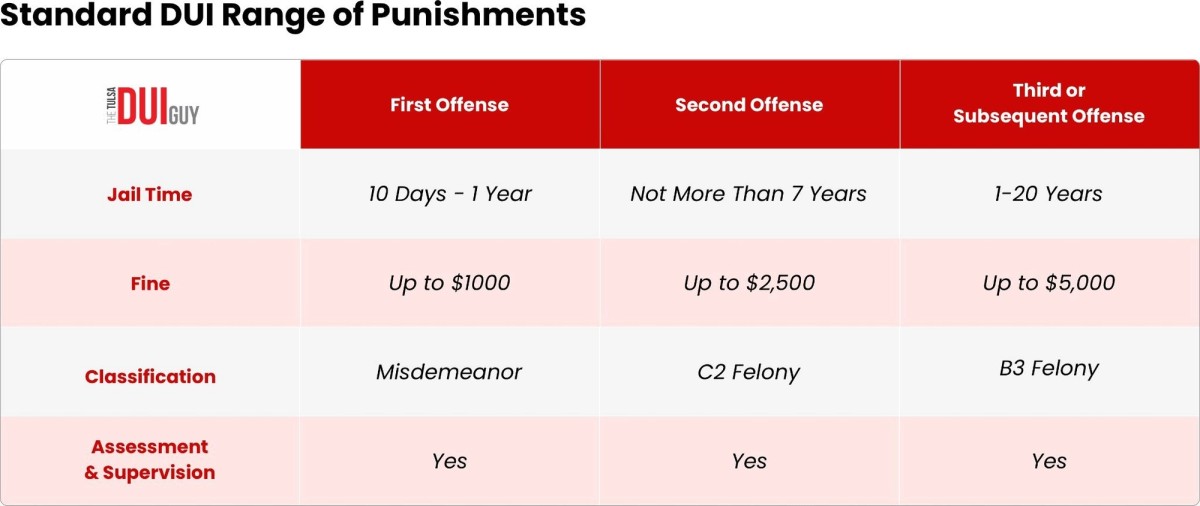
DUI is a predicate offense, which means that punishments increase for subsequent offenses. This means if you get a second or third DUI in less than a ten year period, your punishment will be a lot more severe than a person who only had one offense. Subsequent DUIs are also felonies.
Aggravated DUI (More Severe)
Under the new law, Aggravated DUIs are a much more serious class of offense than they were prior. Any person who commits a DUI while also meeting one (or multiple) of the following conditions is guilty of aggravated DUI:
- Having a BAC of more than 0.15
- Causing a motor vehicle accident, as defined in 47 O.S. § 40-102 (OSCN 2026)
- Driving in a manner that violates the provisions of Section 11-301, 11-302, 11-306, 11-309, or 11-311
- Driving while eluding a police officer
- Driving more than 20 MPH over the speed limit or more than 10 MPH over the speed limit in an active school zone
- Having a passenger less than 18 years of age
- Reckless driving as defined in Section 11-901
All aggravated DUIs are felonies - even a first offense. Ranges of punishment are the same as standard DUIs, except that you must serve the minimum time in jail (or an inpatient treatment facility), regardless of probation, deferral, etc.
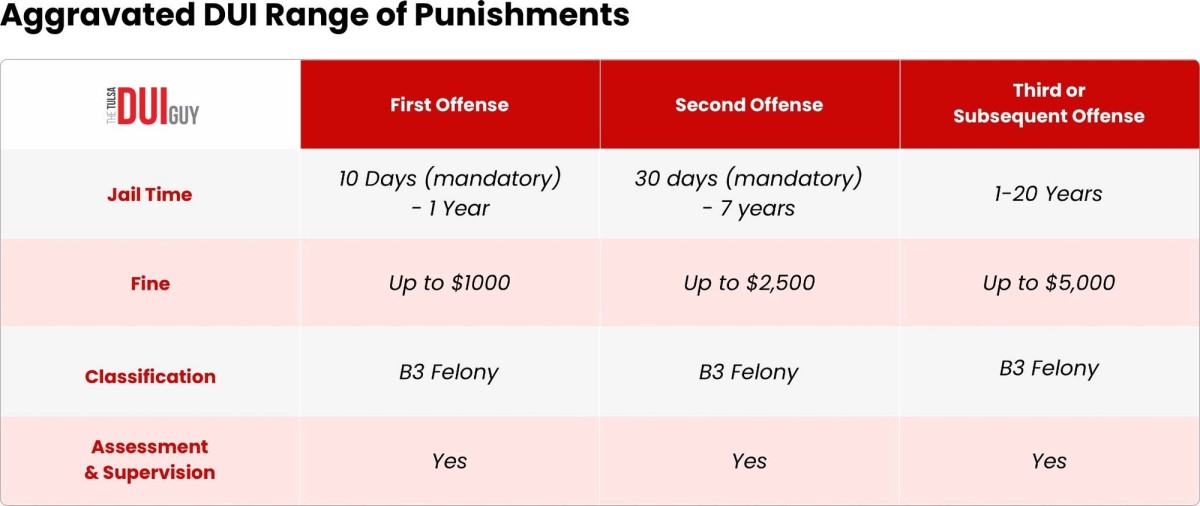
Aggravated DUIs are B3 felonies, which puts them in the same class as domestic abuse with a prior, arson, first degree forgery, drug trafficking, and other major offenses.
DWI: 47 O.S. § 761 (OSCN 2026)
If your blood alcohol content (BAC) does not exceed .08, but is greater than .05 (e.g. .06 or .07), then you can be charged with DWI (Driving While Impaired). DWI only applies to alcohol, and requires that the state prove both your BAC met the criteria AND that your ability to operate a motor vehicle was impaired. If your BAC meets the criteria for a DUI (.08 or above), you are legally assumed to be impaired (see 47 O.S. § 756).
DWI is a misdemeanor, and is not a predicate crime, meaning subsequent offenses are always misdemeanors. DWI is punishable by a fine of $100 - $500 and not more than 6 months in jail.
It’s also important to note that Oklahoma uses the term DWI differently than other states. In some states, the acronym DWI (Driving While Intoxicated) is used instead of DUI, but in Oklahoma, it’s a separate, less serious offense.
Accidents Involving DUIs: 47 O.S. § 11-904 (OSCN 2026)
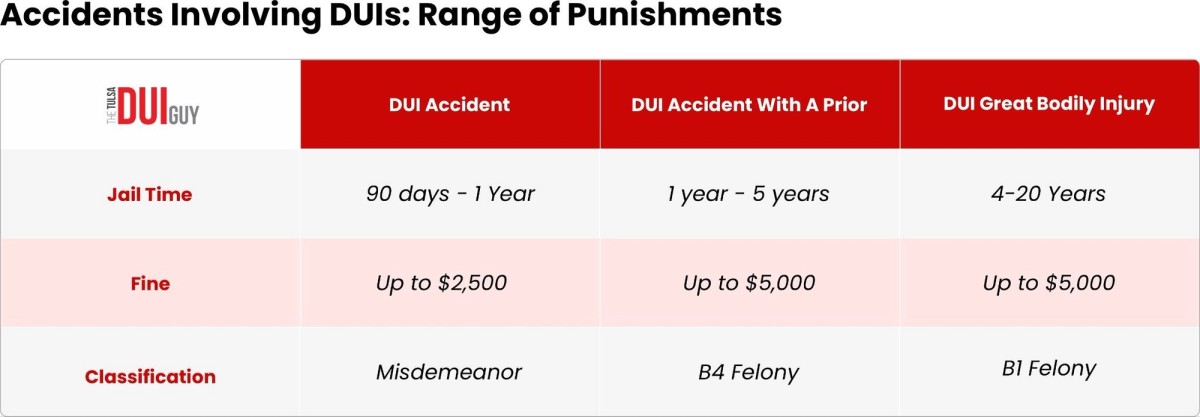
§ 11-904 makes it a crime to get into a personal injury accident while under the influence. If that accident involves a minor personal injury, the first offense is a misdemeanor. If the person committing the offense has a prior DUI or a prior DUI accident, even a minor personal injury becomes a B4 felony.
If the accident involves a "great bodily injury" meaning an injury "which creates a substantial risk of death or which causes serious, permanent disfigurement or protracted loss or impairment of the function of any bodily member or organ," the offense is a B1 felony.
DUI Manslaughter: 21 O.S. § 711 (OSCN 2026), Manslaughter
No specific crime of DUI manslaughter exists in statute. Instead, any Homicide is manslaughter in the first degree when:
- Perpetrated while in the commission of a misdemeanor (e.g. a misdemeanor DUI), without the intent to cause death
- Not perpetrated in a cruel and unusual fashion
- Perpetrated unnecessarily when the victim is in the commission of a crime (e.g. you used deadly force to resist a crime when you didn't need to)
Applies to DUIs where a death happens if the underlying DUI is a misdemeanor. Manslaughter in the first degree is an A2 felony, punishable by not less than 4 years in prison.
DUI Murder: 21 O.S. § 701.8 (OSCN 2026), Murder
Like DUI Manslaughter, no specific crime of DUI murder exists in statute. Instead, any Homicide is a second degree murder when:
1. perpetrated by an act imminently dangerous to another person and evincing a depraved mind, regardless of human life, although without any premeditated design to effect the death of any particular individual; or
2. When perpetrated by a person engaged in the commission of any felony (e.g. a felony DUI) other than the unlawful acts set out in Section 1, subsection B, of this act.
Second degree murder is an A1 felony with a punishment range of 10 years - life in prison.
DUI Under 21: 47 O.S. § 11-906.4 (OSCN 2026)
This statute specifically pertains to drivers under the age of 21. It makes it unlawful for a person to drive, operate, or be in control of a motor vehicle while under the age of 21 and have any measurable amount of alcohol in their breath or blood test.
This statute is infrequently used, because prosecutors can choose to charge you under this statute or under the normal DUI Statute (§ 11-902), where the punishments are more severe.
DUI Child Endangerment: 21 O.S. § 852.1 (OSCN 2026)
This statute is the statute that defines the broader crime of child endangerment, but it includes a provision that makes it a crime to get a DUI while you have a child in the car. Notably, having a child in the car is also an aggravating factor in the DUI statute, so you could be charged with both child endangerment and aggravated DUI if you get a DUI with a child in the car. Violation of this statue is a B6 Felony, punishable by imprisonment up to 4 years and a fine of up to $5000.
Reckless Driving: 47 O.S. § 11-901
The reckless driving statute makes it a crime to drive a motor vehicle in a "careless or wanton manner without regard for the safety of persons or property." While this statute does not directly relate to DUIs, it is used as an aggravating factor, so you could be charged with a much more severe felony aggravated DUI if you were driving “recklessly” as defined here.
Driver’s License Related Statutes
In Oklahoma, a DUI is really two cases. First, you have the criminal case, which involves punishments like fines, jail time, etc. Second, you have the civil license revocation, which is an action that the State’s licensing agency (formerly called the Department of Public Safety, now called Service Oklahoma) takes against you to revoke your driving privileges after you are convicted (or plead guilty to) a DUI.
License Revocation: 47 O.S. § 6-205 and § 6-205.1 (OSCN 2026)
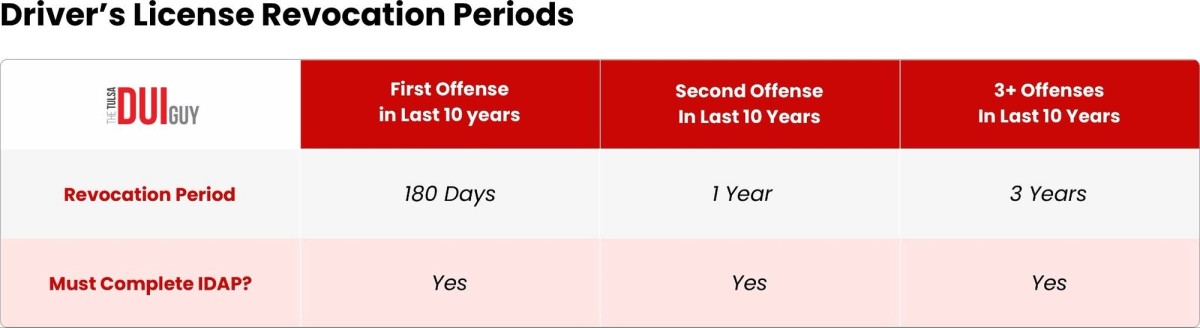
§ 6-205 establishes that Service Oklahoma is required to revoke the Driver's License of anyone who is convicted of certain driving related offenses, including DUIs. § 6-205.1 specifies how long the license should be suspended for each offense.
Service OK Must Give Notice: 47 O.S. § 2-116 (OSCN 2026)
This statute allows Service Oklahoma to mail you notice of your license revocation. The giving of notice by mail is complete 10 days after mailing, which is why you generally have 40 days to appeal your revocation to the district court (10 days for the notice + 30 days under 47 O.S. § 6-211). The statute also specifies that failure to update your address with Service OK is not a valid reason to protest the notice - that’s why we always recommend you update your address immediately after a DUI arrest.
IDAP: 47 O.S. § 6-212.5 (OSCN 2026)
This statute establishes IDAP (The Impaired Driver Accountability Program), which is a program that you are required to complete to have your drivers license reinstated after a DUI conviction. If you participate in IDAP, your license is not revoked as long as you are compliant with the program conditions. The Board of Tests administers the program.
Under IDAP, you are required to:
- Enroll in the program and receive a restricted driver's license
- Pay the program costs
- Install and pay (installation and monthly maintenance) for an interlock device (IID) in your car
- Not have IID (Ignition Interlock Device) Violations, as defined by the Board:
- Three (3) positive result startup tests within a fifteen (15) minute time frame.
- A circumvention (by-passing the correct operation of an interlock device by starting the vehicle, by any means, without first providing a negative result breath alcohol test or passing a confirmatory test).
- A retest violation.*
- Power violation (No power to device for 72 hours or more).
- Permanent lockout**
- Not be arrested for another DUI or APC during the program period
- Not operate a vehicle without an IID unless you receive a waiver (e..g for a work vehicle)
- Have a minimum of 15 tests per 30 calendar days ("participate")
*Although a retest violation may occur, the program completion rules permit some leniency regarding retest violations by allowing up to five (5) retest violations in the last ninety (90) active interlock days.
**Occurs 5 days after a violation is triggered and the user fails to return to the interlock service center.
You are not allowed to sit out your revocation period - you must complete IDAP to have your license reinstated.
Program lengths are listed below and are not eligible to be served concurrently, which equates to one IDAP program length per offense:
- First Offense
- no less than* one hundred eighty (180) active ignition interlock days and program participation criteria as determined by the Board for first offense;
- Second Offense
- no less than* three hundred sixty-five (365) active ignition interlock days and program participation criteria as determined by the Board for second offense;
- Third Or Subsequent Offense
- no less than* seven hundred thirty (730) active ignition interlock days and program participation criteria as determined by the Board for third and subsequent offenses.
*Each program length requires the last ninety (90) active interlock days be violation free, hence the term "no less than".
Requirements For Revocation: 47 O.S. § 754 (OSCN 2026)
This statute establishes what must happen after an arrest in order for your license to be revoked. It requires officers to transmit a sworn report to Service Oklahoma in the event of DUI arrests. Reports issued more than 180 days after an arrest shall be disregarded.
Upon receipt of a report indicating a BAC greater than .08 (or any measurable BAC if less than 21 years of age), Service OK is required to revoke that person's driver's license. Participants in IDAP can keep their driver's license if they meet the program requirements.
The Statute also allows you to appeal your revocation. Related to 47 O.S. § 6-211.
Your Right to Appeal Your License Revocation: 47 O.S. § 6-211 (OSCN 2026)
Everyone who has had their license revoked, whether for a DUI or any other reason, has the right to appeal that revocation to the District Court. You must file an appeal within 30 days of the notice of revocation + 10 days for the notice period provided under 47 O.S. § 2-116 (OSCN 2026).
Courts must set a hearing on the appeal within 60 days. Revocation of your license is stayed pending the outcome of the appeal.
The statue also establishes a cutoff for how long law enforcement has to send the report of your arrest to Service Oklahoma. If the report is transmitted more than 180 days after your arrest, Service Oklahoma can’t revoke your license.
Disqualification from CDLs: 47 O.S. § 6-205.2 (OSCN 2026)
This statute disqualifies any person from holding a CDL (Commercial Driver’s License) if they commit certain crimes, including DUIs. If you are a current holder of a CDL and are convicted of a DUI, you could have your CDL revoked under this statute.
Crucially, a CDL can be revoked for a DUI in any vehicle - not just a commercial vehicle. Revocations are required to last at least 1 year.
The Bottom Line
In the last year, we’ve seen a ton of changes to the DUI laws - with most of the changes oriented around making it easier to get charged with a felony DUI, even for a first offense. It’s more important than ever to know the actual laws so that you can protect your rights.
If you’ve been charged with a DUI, contact us for a free, no obligation consultation about your case.