

Many people know that a second or third DUI is more serious than a first offense, but most don’t understand exactly how Oklahoma law treats repeat DUI convictions. In general, penalties become increasingly severe with each offense and may include longer jail or prison sentences, felony charges, driver’s license consequences, ignition interlock requirements, and additional conditions.
A quick disclaimer: every DUI case is different - the exact outcome depends on factors like p rior convictions, criminal history, aggravating circumstances, the county where the case is filed, and the evidence involved. Let’s dive in.
All Offenses Share Some Common Elements
Whether it’s your first DUI or a repeat offense, there are several sentencing requirements that are always required in DUI cases, including mandatory drug and alcohol assessment, ADSAC (DUI classes), and a Victims Impact Panel. Depending on the circumstances, court costs, fines, probation, community service, driver’s license consequences, and ignition interlock requirements may also be required.
The exact requirements depend on the circumstances of the case and the court.
First DUI
A first DUI is often charged as a misdemeanor unless aggravating circumstances exist. Depending on the facts of the case and prior criminal history, some first-time offenders may qualify for a deferred sentence, while others may receive a suspended sentence or other negotiated resolution.
Potential penalties include:
- Up to one year in jail
- Probation
- Alcohol assessment
- ADSAC
- Victim Impact Panel
- Fines and court costs
- Possible community service
- Driver’s license consequences
Many first-time cases are resolved without jail time, but it depends on the specific facts in the case.
Second DUI
A second DUI within 10 years may be filed as a felony and carry much more serious consequences. Under the new sentencing modernization act, all felonies are categorized into classes depending on the offense. A second DUI charge is classified as a C2 felony, and potential consequences may include:
- Felony conviction
- Up to 7 years in prison
- Probation
- Treatment requirements
- Ignition interlock requirements
- Alcohol assessment
- ADSAC
- Victim Impact Panel
- Court costs and fines
Because felony convictions carry consequences such as firearm restrictions, impacts on employment, and other damaging factors outside of the sentence, it is important to have an experienced attorney evaluate all available options. You also have increased likelihood of serving some jail time if you’re charged with a second DUI.
Third and Subsequent DUIs
Penalties increase again for third and subsequent convictions within 10 years. Third and subsequent DUI convictions are classified as B4 felonies, and often involve:
- Extended prison sentences (up to 10 years)
- Additional supervision requirements
- Mandatory treatment
- Community service requirements
- Extended ignition interlock requirements.
Repeat DUI offenders may also face increased difficulty reaching plea agreements and may face more significant driver’s license consequences.
Aggravated DUI
Under Oklahoma law, certain DUI cases may be charged as aggravated DUIs when a person commits a DUI and one or more aggravating factors are present, including:
- Have a BAC of 0.15 or greater
- Cause a motor vehicle accident, as defined in 47 O.S. § 40-102 (OSCN 2026)
- Drive in a manner that violates the provisions of Section 11-301, 11-302, 11-306, 11-309, or 11-311
- Elude a police officer
- Drive more than 20 MPH over the speed limit or more than 10 MPH over the speed limit in an active school zone
- Have a passenger less than 18 years of age
- Drive recklessly, as defined in Section 11-901
Unlike a standard first-offense DUI, aggravated DUI is charged as a felony, even for first-time offenders.
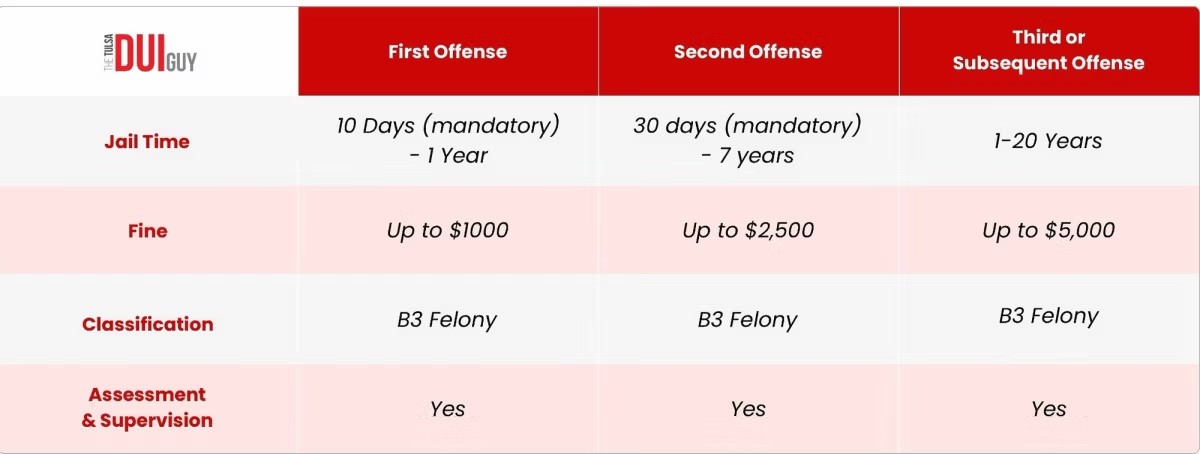
Ranges of punishment are the same as standard DUIs, except that you must serve the minimum time in jail (or an inpatient treatment facility), regardless of probation, deferral, etc. If you are convicted, the range of punishments are set by statute based on whether it was your first, second, or third offense within a ten year period.
Potential punishments for an aggravated DUI include:
Frequently Asked Questions
Is a first DUI always a misdemeanor?
Not always. While many first DUIs are filed as misdemeanors, certain aggravating factors may elevate the charge to a felony.
Can a second DUI become a felony?
Yes. If you’ve had a prior DUI conviction within the last 10 years, it may be filed as a felony. Aggravating factors and other specific facts of the case may also enhance a second DUI charge to a felony, regardless of whether you have a prior offense.
Will I go to jail for a repeat DUI?
Maybe. Your odds of serving jail time go up with repeat DUI offenses. If you’re facing a repeat offense charge, it’s even more important to aggressively challenge the State’s case in order to get the best possible outcome.
Will I have to serve the full prison sentence?
Not necessarily. Depending on the felony classification, you are required to serve a specific percentage of your sentence in prison. For example, if you are convicted of a C2 felony (second DUI conviction), you are required to serve at least 20% of your sentence. The specific term length depends on the offense, classification, and other factors of your case.
Will I lose my driver’s license?
A DUI arrest can result in driver’s license consequences, but many drivers have options to continue driving legally, including participation in Oklahoma’s Impaired Driver Accountability Program (IDAP).
Will I be on probation?
Possibly. It is even more likely if it is your first offense. Many DUI cases are resolved through deferred sentences, suspended sentences, or probation, rather than extended jail time for eligible offenders.
Can a DUI be dismissed?
Yes. DUI cases are sometimes dismissed because of insufficient evidence, constitutional violations, breath or blood testing issues, or other weaknesses in the prosecution’s case.
Can I get a deferred sentence for a DUI?
Many first-time offenders may qualify for a deferred sentence, allowing the case to be dismissed after successful completion of the court’s requirements.
Can a DUI be expunged?
Some DUI cases may become eligible for expungement after the case is resolved, the statutory waiting period is over, and eligibility requirements have been met.
The Bottom Line
Every additional DUI conviction carries greater consequences under Oklahoma law. What begins as a misdemeanor may eventually become a felony with significantly greater penalties, longer supervision, and lasting future impacts.
If you’ve been charged with a DUI in Oklahoma, reach out to speak with an experienced DUI attorney to review your case, explain the potential penalties, and help protect your rights.